Unconfirmed news reports that the U.S. Secretary of Defense gave verbal orders that all of the occupants of the first alleged drug smuggling boat attacked by the U.S. Navy in the Caribbean were to be killed hit like a thunderbolt. Not, mind you, that it was a surprise to many of us who have been following this questionable deployment of U.S. military might since it began on September 2, 2025. When the initial strike did not kill everyone on board, according to a CNN report on November 39, a follow-up strike was launched, killing survivors clinging to the wreckage and sinking the ship.
The report said that before the operation, the Secretary of Defense ordered the military to ensure the strike killed everyone on board the vessel. It’s unclear whether he knew of the survivors before the second strike, and when the administration announced the strike, no mention was made of killing survivors. Unnamed officials acknowledged, according to CNN, that they did not know the identities of everyone on board the boat before the first strike.
The details of who said what, who issued what orders, and why remain unclear. Quoting an article in The Washington Post, ABC News alleges that Admiral Mitch Bradley, commander of Special Operations Command, ordered a second strike after the initial strike left two survivors clinging to the boat. The second strike was to comply with Defense Secretary Pete Hegseth’s orders and to ensure that survivors couldn’t call on other traffickers to retrieve them and their cargo. In a September 28 social media post, Hegseth wrote that the strikes were intended to be “lethal kinetic strikes.” He also claimed that the operations are ‘lawful under both U.S. and international law, and in compliance with the law of armed conflict, and approved by the best military and civilian lawyers, up and down the chain of command.’
It’s worth noting that in his September social media post, Hegseth neither confirmed nor denied the report that he’d ordered that there be no survivors. There was also no explanation of why the U.S. forces were not ordered to retrieve the survivors and their cargo from the water, as they did in a subsequent strike when helicopters retrieved two survivors, who were repatriated to Ecuador and Colombia, rather than transported to the U.S. to be prosecuted in a U.S. court for narcotics smuggling.
On November 28, after the report came out regarding the second strike, Hegseth posted the following on social media: “As usual, the fake news is delivering more fabricated, inflammatory, and derogatory reporting to discredit our incredible warriors fighting to protect the homeland.” Not exactly a detailed denial. Speaking to reporters on Air Force One on November 30, President Donald Trump said that Hegseth denied giving such an order. “He said he did not say that, and I believe him 100%,” Trump said.
While responses to this reporting have been unsurprisingly partisan, there have also been bipartisan expressions of concern that, if true, the second strike on the first boar violated the law. There has finally been a call for a congressional hearing into the matter, with support from both Democrats and Republicans.
As with many actions of this administration, their response to questions about this has raised more questions than it has answered, and their actions from the start have been called into question, on both legal and moral grounds.
Here are some questions that any congressional inquiry should demand the administration answer:
1. Demand that DOJ provide detailed support for its opinion that service members who participate in the boat strikes cannot be prosecuted, and how it came to the conclusion that the strikes were ordered, ‘consistent with the laws of armed conflict, and are, therefore, lawful orders which must be obeyed. How does DOJ explain the need for such an opinion, in advance of the strikes, if they’re lawful, and on what basis does DOJ determine that this is a non-international armed conflict and domestic self-defense against drug traffickers?
2. Demand that the Defense Secretary identify the ‘best military and civilian lawyers’ who ‘approved’ the operations.
3. If the second strike in the first attack was lawful, why were survivors retrieved in the second attack?
4. If this is to protect the U.S. against narco-traffickers, why were the two subsequent survivors repatriated to foreign countries rather than being brought to the U.S. for prosecution?
5. Why has no evidence of drugs been gathered and presented in any of the strikes so far?
6. How has the administration determined that the boats attacked were, in fact, transporting illegal drugs, and what were their destinations?
These are just a few basic, baseline questions that come to mind as a former career military officer who, if ordered to participate in such an operation, would want answers before taking any action. During my 20-year career, I was always taught that even in combat, there are lines you do not cross, and one of these is that when an enemy can no longer offer resistance, such as when he is clinging to the wreckage of a boat in the middle of the ocean, you do not kill him. The laws of war and the UCMJ require that you render assistance.
It appears to me that a line has been crossed in these operations. The question is, who should be held responsible?
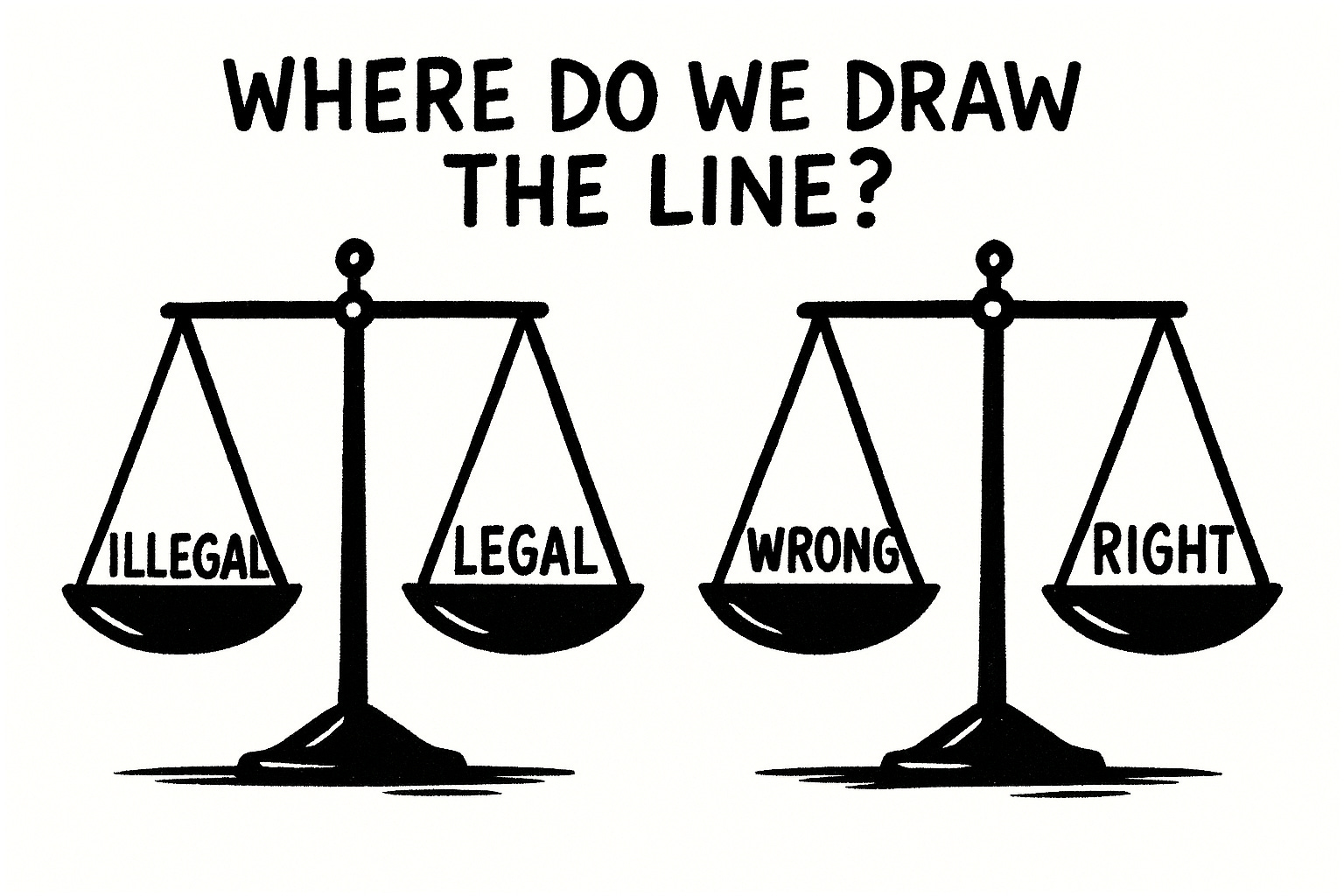
And it’s not just a question of legality. In addition to the legal ramifications, those involved have to consider the morality of it all. While I believe these operations are illegal, that’s just my opinion, which competent legal authorities may contradict. What cannot be gainsaid, though, is that, morally, they are just plain wrong.